

Your team’s last architecture debate probably wasn’t about architecture at all.
I’ve spent countless hours watching brilliant engineers argue about microservices, coding standards, and delivery timelines. Want to know the real kicker? Most of these “technical” debates aren’t technical at all – they’re human conflicts wearing a technical hat.
Let me share something that transformed how I handle team disagreements: the Thomas-Kilmann model. It’s not another framework to add to your already-overflowing tech stack. Instead, it’s a lens that reveals why your best engineers might be talking past each other (and what to do about it).
The Five Flavors of Conflict
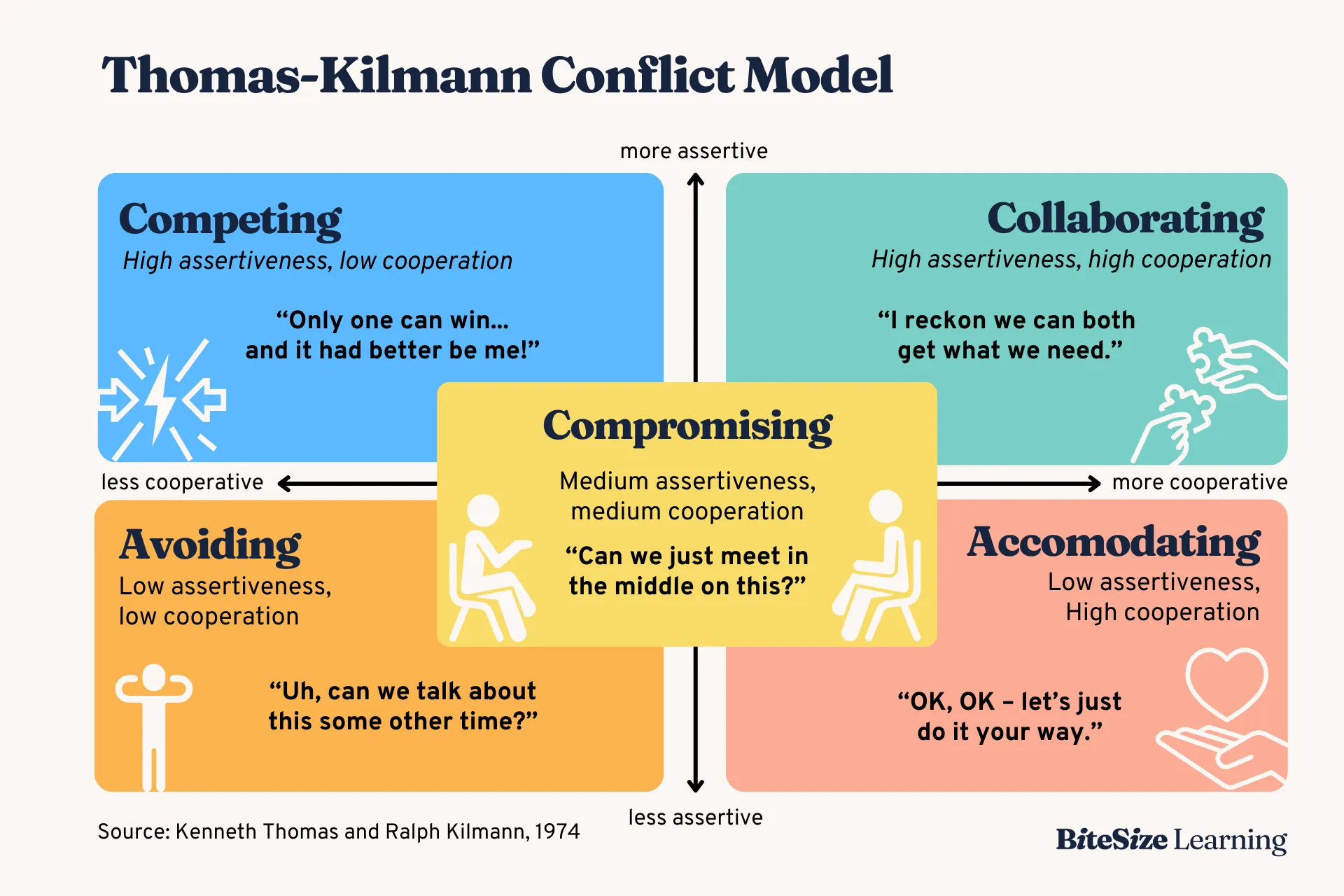
Picture this: Two axes – Assertiveness (how much you push for your own way) and Cooperativeness (how much you work with others). This creates five distinct ways people handle conflict:
- The Bulldozer (Competing)
- “My way or the highway”
- Great for: Production emergencies
- Terrible for: Team morale, pretty much everything else
- The Bridge Builder (Collaborating)
- “Let’s find the best solution together”
- Great for: Complex architectural decisions
- Terrible for: When the building’s on fire
- The Diplomat (Compromising)
- “Let’s meet in the middle”
- Great for: Sprint planning disputes
- Terrible for: Core technical values
- The Ghost (Avoiding)
- “What conflict? I don’t see any conflict”
- Great for: Cooling heated moments
- Terrible for: Actually solving anything
- The Pushover (Accommodating)
- “Whatever you think is best”
- Great for: Building relationship credit
- Terrible for: Your long-term sanity
https://www.bitesizelearning.co.uk/resources/thomas-kilmann-conflict-model
Why This Matters
Let me tell you about a recent train wreck I witnessed. Two senior engineers were locked in an endless debate about moving to microservices. One kept pushing hard (Competing), while the other kept backing down (Accommodating).
The real issue? Not architecture at all. The “Competitor” was worried about scaling the team, while the “Accommodator” was concerned about maintenance complexity. Both valid points, totally different conversations.
Three Ways to Use This Tomorrow
- Know Your Default Mode — Look, I’ll go first – I’m naturally an Avoider. I hate conflict. But knowing this helps me consciously choose when to step up instead of step back.
- Spot Others’ Patterns — That teammate who always pushes their solution? Classic Competitor. The one who always says, “whatever works for everyone”? Textbook Accommodator. Knowing this helps you adapt your approach.
- Change the Game — Here’s the magic move: When you spot someone in Competing mode, don’t compete back. Try collaboration instead. It’s like jiu-jitsu for office politics.
The Plot Twist
Here’s what nobody tells you: No mode is “best.” Even Collaboration, which sounds ideal, isn’t always right. Sometimes you need quick decisions (Competing), sometimes you need to preserve relationships (Accommodating), and sometimes you really do need to hit pause (Avoiding).
The Real Win
The goal isn’t to eliminate conflict – that’s impossible and actually undesirable. The goal is to handle it productively.
Next time you’re in a technical debate that seems to be going nowhere:
- Step back
- Identify the modes at play
- Choose your response consciously
- Focus on outcomes, not winning
Remember: That heated debate about tabs vs. spaces? It might not be about formatting at all. Maybe it’s about feeling respected, heard, or valued.
I’ve written in the past about why we should stop winning arguments.
Pro tip: If you notice the same people always clashing in the same ways, try mapping their conflict modes. It’s like having the cheat codes to team dynamics.
What’s your default conflict mode? Has it served you well in tech leadership?
PS: Yes, I used the Avoiding mode while writing this post. I got up and made tea twice. Self-awareness is a journey, folks.