

Companies often search for complex solutions to boost productivity. Yet, the most significant problem is often glaringly obvious: high Work-In-Progress (WIP). This issue, while apparent, is frequently overlooked as teams scramble to find more intricate answers to their efficiency woes.
The Overlooked Culprit
In my consultations with companies worldwide, I consistently hear complaints about slow delivery. Upon closer examination, the culprit is almost always high WIP — too many tasks being juggled simultaneously.
When confronted with this, the typical response is:
“But we have so much to do! There’s nothing we can do about it.”
This reaction is commonplace. The problem is obvious, yet we walk right past it, searching for more complex issues to solve.
High WIP is detrimental to business, innovation, and morale. It results in stressed teams without significant accomplishments to show for their efforts. Pushing features to production becomes an uphill battle, with progress constantly sliding backwards.
Understanding the Impact of High WIP
When teams work on too many things at once, they create a traffic jam of tasks. Everyone is busy, but actual progress is minimal. It’s akin to a supermarket cashier who’s 100% occupied: a line inevitably forms. In software development, that line consists of features waiting to be completed.
The collaborative nature of software development exacerbates this issue. When you’re too busy, not only is your work waiting, but the work of others is also delayed. This interdependence makes being busy exponentially worse, as it creates a work traffic jam that impedes everyone’s progress.
Real-World Example: The Overburdened Startup
Consider TechNova, a promising startup developing an AI-powered project management tool. Their small team of talented developers each juggle multiple features:
- Alice simultaneously works on UI redesign, implementing a new algorithm, and fixing critical bugs.
- Bob develops the mobile app, integrates a third-party API, and optimizes database queries.
- Charlie sets up the CI/CD pipeline, writes documentation, and creates demo videos for investors.
While it might seem like they’re making progress on many fronts, in reality, TechNova is suffering from high WIP. Features take weeks longer than estimated, quality suffers, and team morale plummets.
The Queuing Theory Perspective
Queuing theory, particularly the concept of utilization, provides insight into why high WIP is so detrimental. As utilization approaches 100%, the wait time for service approaches infinity.
In practical terms, as your team gets closer to full utilization (everyone being 100% busy), the time to complete any given task skyrockets. This is counterintuitive but mathematically proven.
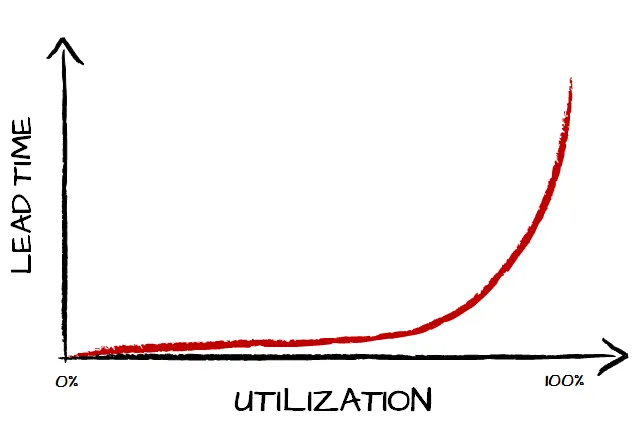
Let’s break it down:
- At 50% utilization, tasks flow smoothly and are completed quickly.
- At 70% utilization, some delays occur, but the situation remains manageable.
- At 90% utilization, wait times become significant. Tasks that used to take days now take weeks.
- At 99% utilization, the system essentially grinds to a halt. Everything takes an eternity.
This illustrates why keeping everyone “busy” all the time is actually detrimental to productivity. It’s not about how occupied people are, but how efficiently work flows through the system.
High WIP’s Effect on Focus
Beyond the mathematical implications, high WIP severely impacts cognitive function and focus. The human brain isn’t designed for constant context-switching. Every task switch incurs a cognitive cost.
Studies show it can take up to 23 minutes to fully regain focus after a distraction. In a high WIP environment, where developers juggle multiple tasks, they might never reach that deep, productive flow state.
Real-World Example: The Context-Switching Nightmare
At DataDynamo, a data analytics firm, developers are expected to work on at least three projects simultaneously. Here’s a typical day for Sarah, a senior developer:
9:00 AM: Start working on Project A’s database optimization
9:30 AM: Urgent bug reported in Project B, switch to investigate
10:15 AM: Back to Project A
10:45 AM: Team meeting for Project C
11:30 AM: Try to resume work on Project A, but can’t remember where she left off
12:00 PM: Lunch break
1:00 PM: Work on Project C deliverables
2:30 PM: Another critical issue in Project B
3:15 PM: Attempt to continue Project A work
4:00 PM: Project D kick-off meeting
5:00 PM: Realize very little progress was made on any project
Sarah ends her day feeling exhausted and frustrated, despite being “busy” all day.
12 Signs Your WIP is Too High
- Immediate help is impossible: Same-day assistance is unavailable due to full schedules.
- Unexpected events cause chaos: Unplanned occurrences lead to immediate delays and frustration.
- Calendar congestion: Scheduling a meeting within the same week is a struggle.
- End-of-day exhaustion: Constant context switching leads to mental fatigue.
- Frequent production issues: Lack of focus results in quality and scalability problems.
- Cascading delays: Delays create new delays in a vicious cycle.
- Distracted meeting participants: People rush through meetings, preoccupied with other tasks.
- Webcams off: Team members multitask during virtual meetings.
- Meeting overload complaints: Frequent meetings prevent deep work.
- Unclear sprint goals: Teams can’t set clear objectives due to numerous ongoing tasks.
- Objective amnesia: Managers can’t list current objectives from memory.
- Cluttered roadmaps: Too many simultaneous initiatives make visualization difficult.
The Counterintuitive Solution
To complete more features, allow for more “laziness.” This sounds counterintuitive, but when everyone is 100% busy, features progress at a glacial pace.
Consider a busy emergency room. When medical staff are constantly occupied, patients wait endlessly. In software development, those waiting “patients” are your features, and their delays are costly.
Every week a feature is delayed costs money equal to the delay cost. We obsess over keeping every developer busy, forgetting the most expensive outcome: features that move at a glacial pace due to high WIP.
Embracing “Laziness” for Productivity
It’s beneficial for developers to have slack time for personal development. This indicates a healthy system that isn’t optimized solely for keeping everyone busy. We should optimize for delivering value quickly, which counterintuitively means people shouldn’t be fully occupied.
If everyone is fully busy, your features are likely stagnant. The team scrambles to juggle multiple tasks while actual progress remains minimal.
Being constantly busy isn’t praiseworthy. It’s a symptom of dysfunction, indicating a system that prioritizes keeping people occupied over moving work efficiently.
The Path Forward
To address high WIP and boost productivity:
- Reduce simultaneous work: Focus on fewer tasks. Prioritize ruthlessly.
- Build in slack: Allow time for unexpected issues and creative thinking.
- Optimize for value delivery: Focus on completing features rather than starting new ones.
- Embrace “laziness”: Allow team members downtime between tasks.
- Visualize your work: Use Kanban boards to identify bottlenecks and overload.
- Set WIP limits: Establish maximum limits for in-progress tasks at each workflow stage.
- Focus on flow efficiency: Optimize for smooth work flow, not resource utilization.
- Regular WIP reviews: Periodically review ongoing work. Be ready to pause or terminate misaligned projects.
- Educate stakeholders: Help others understand the cost of high WIP and benefits of focus.
- Celebrate completion, not starts: Value finishing work more than initiating new projects.
High WIP not only slows current work but also incurs hidden costs:
- Decreased quality: Rushed work and frequent context switches increase errors.
- Reduced innovation: Lack of slack time hinders creative thinking and experimentation.
- Lower morale: Constant overwork leads to burnout and decreased job satisfaction.
- Increased technical debt: Shortcuts taken to juggle priorities accumulate over time.
- Missed opportunities: Being too busy to respond to market changes can be costly.
Conclusion: Let Your Features Sweat
Your productivity boost isn’t hiding in a new framework or tool. It’s right there in plain sight: reduce your WIP. Give your team some breathing room, and watch your features progress rapidly.
Don’t let your developers sweat while your features stagnate. Flip the script and let your work progress speak for itself. By addressing high WIP, you’re not settling for mediocrity – you’re optimizing for real productivity and value delivery.
The solution to your productivity woes is obvious once you recognize it. Reduce your WIP, embrace some “laziness,” and watch your productivity soar.
Remember, effective organizations deliver value. It’s not about how busy your people appear, but how efficiently you complete work. Make your features sweat, not your developers.