

Welcome back, retrospective rock stars! We’re four deep into our “Make Your Team Less Dysfunctional” series, and if you’re not improving by now, well… maybe try interpretive dance? But before you bust out those leotards, let’s dive into our latest retrospective technique: The Starfish Method.
We’ve already covered the straightforward Start Stop Continue, took a nautical adventure with the Sailboat Retrospective, and got in touch with our feelings in the Mad Sad Glad session. Now, it’s time to channel your inner marine biologist and embrace the Starfish!
What the Shell is a Starfish Retrospective?
First off, no actual starfish were harmed in the making of this retrospective. Developed by the brilliant Patrick Kua (not a starfish, as far as we know), this method is like the Swiss Army knife of retrospectives – it’s got a tool for everything.
Picture a starfish. No, not Patrick from SpongeBob. A real starfish. Got it? Good. Now imagine each arm represents a different aspect of your team’s process:
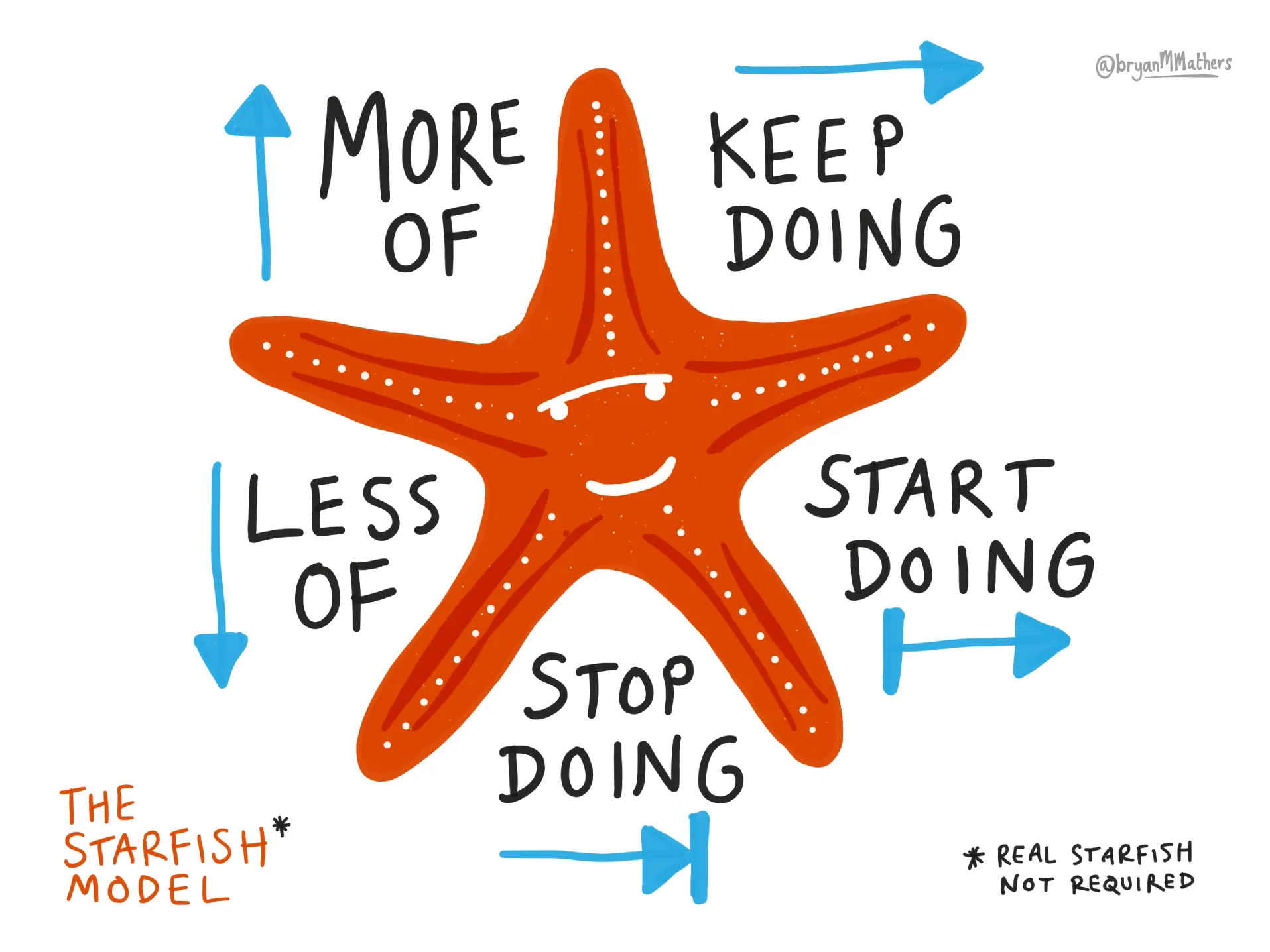
- Keep Doing: The stuff that’s working so well, you’d clone it if you could.
- Less Of: Things you’d like to see as often as your in-laws. (Sorry, in-laws.)
- More Of: The good stuff you want to supersize.
- Stop Doing: The practices you want to ghost faster than a bad Tinder date.
- Start Doing: New ideas you want to take for a spin.
It’s like a five-armed compass guiding you through the treacherous waters of team improvement. And unlike a real starfish, this one won’t regenerate its arms if you cut them off. So, handle with care!
Why Should You Give a Barnacle?
I know what you’re thinking. “Another retrospective method? I barely have time for my actual work!” But hear me out:
- It’s Comprehensive: Covers everything from “never do this again” to “let’s clone this process.”
- It’s Balanced: Equal focus on the good, the bad, and the “meh.”
- It’s Forward-Thinking: Not just about what went wrong, but what could go right.
- It’s Empowering: Gives everyone a voice in shaping the team’s future.
- It Ends on a High Note: **“**By finishing with Start Doing,” you leave feeling optimistic. (Unlike that time you tried to make sourdough bread during lockdown.)
Plus, it’s a great excuse to draw a starfish on the whiteboard. Art therapy, anyone?
How to Run This Sea-sonal Spectacle
Ready to dive in? Here’s your step-by-step guide to not making a total shipwreck of your Starfish Retrospective:
- Set the Stage: Draw a starfish on the board (or use a digital tool like Miro/Canva/etc. if your artistic skills are as bad as mine). Label each arm with one of the five categories.
- Brainstorm: Give everyone time to jot down ideas for each category. Pro tip: Use different colored sticky notes for each arm. It’ll look like a disco starfish!
- Share and Stick: Have team members share their ideas and stick them on the appropriate arm of the starfish. No judgment here – unless someone suggests “more meetings” in the “More Of” category. Then you can judge.
- Group and Vote: Cluster similar ideas and have the team vote on priorities. Democracy in action, folks!
- Discuss and Plan: Start with “Stop Doing” and work your way clockwise. For each item, discuss why it’s important and how to act on it.
- Action Items: End with concrete action items for each category. Assign owners and deadlines, or it’ll be as effective as a chocolate teapot.
The whole shebang should take about 90 minutes. That’s less time than it takes to watch “Finding Nemo,” and potentially more enlightening about marine life.
Real Talk: Examples to Get Your Tentacles Tingling
Still feeling like a fish out of water? Here are some examples to get your creative juices flowing:
Keep Doing:
- Daily stand-ups (they actually start on time now!)
- Peer code reviews (catching bugs faster than a chameleon catches flies)
- Friday team lunches (because food is the ultimate motivator)
Less Of:
- Unscheduled “quick chats” that turn into hour-long debates
- Overcommitting in sprint planning (we’re optimists, not magicians)
- Using “ASAP” in task descriptions (everything can’t be ASAP, Bob)
More Of:
- Pair programming sessions (two heads are better than one, unless you’re a Hydra)
- Documentation (future you will thank present you)
- Celebrating small wins (because who doesn’t love a good happy dance?)
Stop Doing:
- Midnight deploys (we’re developers, not vampires)
- Skipping retrospectives (yes, the irony is not lost on me)
- Blaming the intern (they’re trying their best, okay?)
Start Doing:
- Regular knowledge sharing sessions (spread that brain wealth)
- Rotating Scrum Master role (share the joy… and the pain)
- Team book club (50 Shades of Agile, anyone?)
Wrap It Up with a Starfish Bow
The Starfish Retrospective isn’t just about drawing sea creatures in the office (though that’s a fun bonus). It’s about taking a holistic look at your team’s processes and charting a course for improvement.
So, are you ready to be the Patrick Star of your development team? Will you embrace the wisdom of the starfish, or will you continue to flounder in the sea of mediocrity? The choice is yours, you beautiful tropical fish.
Remember, whether you’re starting and stopping, sailing the high seas, navigating emotional waters, or now, embracing your inner echinoderm, the key is to keep evolving. Just like a starfish regenerating its arms, your team can always grow and improve.
Have you tried the Starfish Retrospective? Did it make waves in your team, or did it leave you feeling a bit crabby? Share your experiences in the comments below. And if this post helped your team see stars (in a good way), consider buying me a pet starfish. Or maybe just a goldfish. I hear they’re easier to keep alive.
Stay tuned for the next chapter in our retrospective saga. It’s going to be stellar! (I promise that’s the last star pun. Maybe.)