

The best leaders know themselves. The exceptional ones help their teams do the same.
In the fast-paced world of tech, where lines of code and system architectures often take center stage, it’s easy to overlook the most critical component of any successful team: the human element.
As a tech leader, you’re not just managing projects or overseeing sprints – you’re guiding a group of brilliant, complex individuals. And let’s face it, sometimes understanding people (including yourself) can be harder than debugging a gnarly piece of legacy code.
Enter the Johari Window – a psychological tool that’s about to become your new favorite framework. No, it’s not named after some obscure programming language or a new JavaScript library. It’s a powerful model for improving self-awareness and team dynamics that’s been hiding in plain sight since the 1950s.
Why Does This Matter for Tech Leadership?
In an industry where technical skills often take center stage, it’s easy to overlook the human element. But the most successful tech companies aren’t just those with the most advanced tech stacks or the most elegant algorithms. They’re the ones with leaders who can build cohesive, high-performing teams. They’re the ones who recognize that emotional intelligence and self-awareness are just as crucial as technical expertise.
The Johari Window gives you a framework to develop these critical soft skills. It’s like a debugging tool for your leadership style, helping you identify blind spots, uncover hidden potential, and create an environment where your team can thrive.
In the following sections, we’ll dive deep into the four quadrants of the Johari Window, explore how to apply it in a tech leadership context, and provide practical exercises you can start using with your team today. We’ll also look at common pitfalls to avoid and the tangible ROI of investing in self-awareness.
Are you ready to level up your leadership game? Let’s open up the Johari Window and see what we discover.
The Four Quadrants of the Johari Window
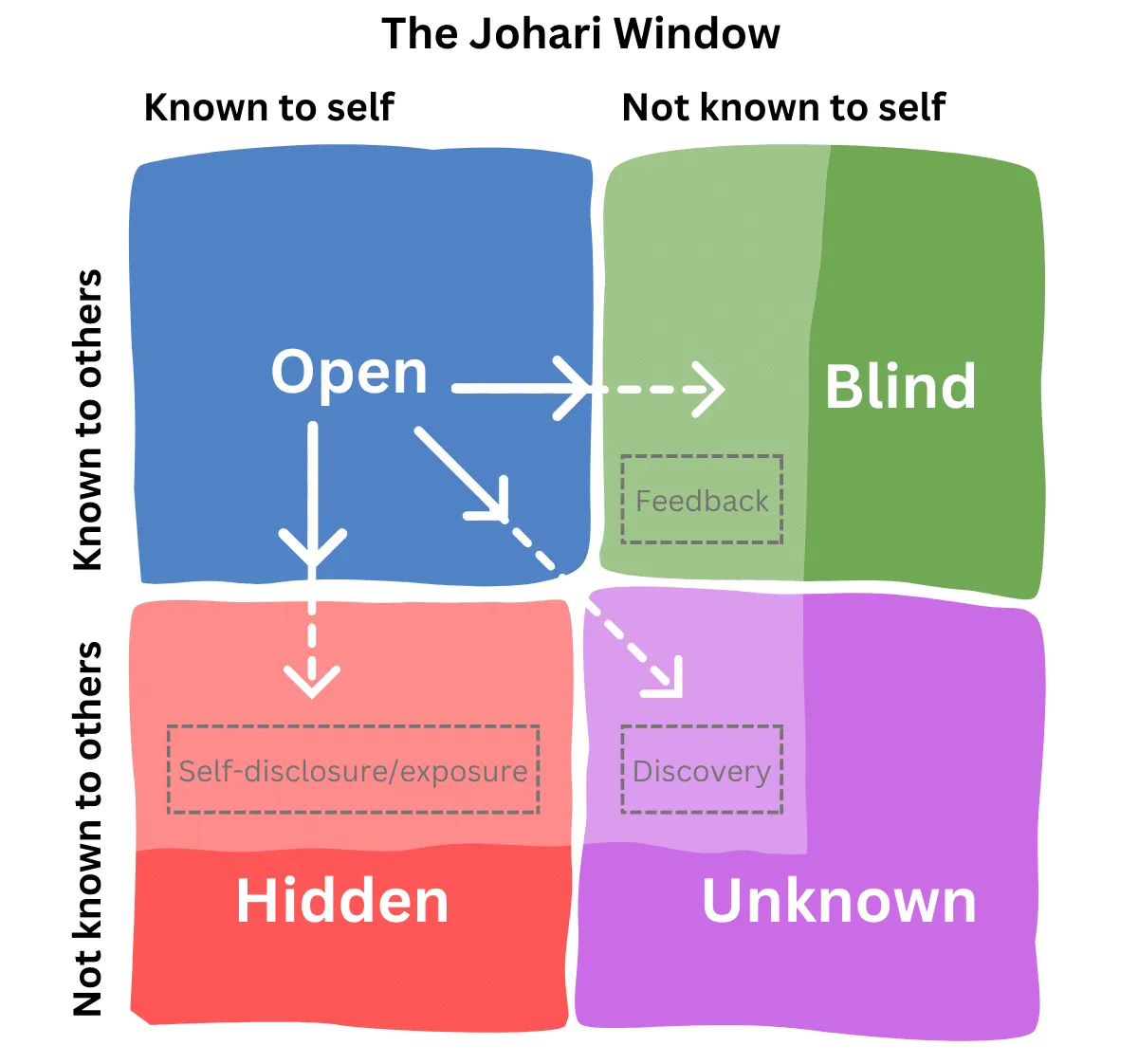
Before we dive into how this applies to tech leadership, let’s break down the basics. The Johari Window isn’t about actual windows (sorry, frontend devs). It’s a 2×2 grid with four quadrants that represent different aspects of self-awareness and interpersonal dynamics. Think of it as a SWOT analysis for your personality.
- Open Area (Arena)
This is the “public” you. The skills, knowledge, and behaviors that both you and others know about. It’s like your LinkedIn profile, but honest. In a tech context, this might include your coding languages, your knack for debugging, or your ability to explain complex concepts in simple terms.
For example, everyone on your team might know that you’re a whiz at optimizing database queries and that you always bring donuts to Friday standups. The larger this area, the more transparent and effective your communication tends to be.
- Blind Spot
Here’s where it gets interesting. These are things others know about you, but you don’t realize about yourself. Maybe you have a habit of interrupting during standups, or perhaps you’re actually a CSS genius but don’t recognize it.
In tech leadership, your blind spots could be seriously impacting your team’s performance. For instance, you might think you’re great at delegating, but your team feels micromanaged. Or you might not realize that your “constructive criticism” comes across as harsh and demotivating.
- Hidden Area (Façade)
This is what you know about yourself but keep hidden from others. It could be your secret talent for interpretive dance, or your crippling impostor syndrome. In a professional context, it might be your uncertainty about a new technology stack, or your struggle with work-life balance.
While it’s natural and sometimes necessary to keep some things private, an overly large hidden area can hinder trust and authentic communication within your team.
- Unknown Area
This is the realm of untapped potential. Things neither you nor others know about you. Maybe you’d be an amazing public speaker, or perhaps you have a knack for quantum computing that you haven’t discovered yet.
In tech, where the landscape is constantly evolving, this quadrant is particularly exciting. It represents the skills you might develop, the leadership potential you haven’t tapped, and the innovative ideas you haven’t even dreamed up yet.
The goal of using the Johari Window is to expand that Open Area. The larger it is, the more effectively you can lead, communicate, and collaborate. It’s like increasing your codebase’s test coverage, but for your personality.
In the next sections, we’ll explore how to apply this model specifically to tech leadership, with practical strategies for expanding your Open Area and leveraging the insights from each quadrant to become a more effective leader.
Johari Window Team Workshop Playbook
Objective: To help team members understand themselves and each other better, improving communication and collaboration.
Duration: 2-3 hours
Materials Needed:
- Large whiteboard or virtual whiteboard (e.g., Miro)
- Sticky notes (physical or virtual)
- Pens
- Timer
- Introduction (15 minutes)
- Explain the Johari Window concept and its four quadrants
- Emphasize the importance of honesty and psychological safety
- Set ground rules for respectful communication
- Individual Reflection (20 minutes)
- Have each team member write down:
- 5 professional qualities they believe they possess (Open Area)
- 3 skills they’d like to improve (Hidden Area)
- 2 areas where they’d like feedback (potential Blind Spot)
- 1 wild career aspiration (Unknown Area)
- Have each team member write down:
- Open Area Expansion (30 minutes)
- Each person shares their 5 qualities with the group
- Team members add sticky notes with additional positive qualities they’ve observed
- Discuss any surprising additions
- Blind Spot Exploration (40 minutes)
- Form pairs or small groups
- Each person shares the areas where they want feedback
- Partners provide constructive feedback
- Return to the larger group and share key insights
- Hidden Area Reveal (30 minutes)
- Voluntary sharing of skills team members want to improve
- Brainstorm ways the team can support each other’s growth
- Identify any common areas for team-wide improvement
- Unknown Area Speculation (20 minutes)
- Share wild career aspirations
- Team members suggest potential hidden talents or opportunities for each other
- Discuss how to create space for exploration and growth within the team
- Team Johari Window (30 minutes)
- Create a large Johari Window for the entire team
- Collaboratively fill in each quadrant based on the day’s discussions
- Identify team-wide strengths, blind spots, hidden challenges, and growth opportunities
- Action Planning (15 minutes)
- Individual: Each person writes down one action to expand their Open Area
- Team: Decide on 2-3 team-wide initiatives based on the workshop insights
- Closing Reflection (10 minutes)
- Go around the room, with each person sharing one key takeaway
- Discuss how to keep the Johari Window conversation ongoing
Follow-up:
- Schedule one-on-one meetings to discuss individual insights further
- Plan a follow-up session in 3-6 months to reassess and see how the team’s window has changed
Remember to adapt this playbook based on your team’s size, dynamics, and comfort level with sharing. The key is to create a safe space for open, honest communication and self-reflection.
Applying the Johari Window in Tech Leadership
Now that we’ve mapped out the terrain of the Johari Window, let’s explore how to navigate it in the context of tech leadership. This isn’t just theoretical mumbo-jumbo – it’s about leveraging self-awareness to create high-performing, innovative teams.
Building Trust and Psychological Safety
In tech, we often hide behind our screens and our code. But great leadership requires vulnerability. By sharing more about yourself (expanding your Open Area), you create an environment where team members feel safe to do the same.
Try this: At your next team meeting, share a time when you royally screwed up a deployment. Maybe you pushed to production at 4:59 PM on a Friday and spent the weekend frantically rolling back changes. Watch how this openness encourages others to share their own experiences and learnings.
Remember, psychological safety isn’t about being nice. It’s about creating an environment where it’s okay to take risks, ask questions, and make mistakes. It’s the difference between a team that’s afraid to touch legacy code and one that confidently refactors it.
The Johari Window is essentially a feedback model on steroids. It encourages both self-disclosure and seeking feedback from others. In tech terms, think of it as continuous integration for your leadership skills.
Improving Communication and Feedback Loops
Implement a regular “360 review” process, but make it less formal and more frequent. Quick check-ins where team members can provide feedback on your leadership style can help shrink your Blind Spot and make you a more effective leader.
For example, you might think you’re great at explaining technical concepts, but your team might be nodding along while secretly Googling everything you say. Regular feedback can help you adjust your communication style and ensure everyone’s on the same page.
Fostering Innovation and Creativity
The Unknown Area is where innovation lives. By encouraging exploration and risk-taking, you can help your team (and yourself) tap into unknown potential.
Set up regular “hack days” where team members can work on whatever they want. You might discover that your backend developer has a flair for UX design, or that your QA engineer has brilliant ideas for new features.
Remember, Google’s Gmail and 20% time policy came from this kind of exploration. Who knows what your team might come up with when given the freedom to explore?
Enhancing Team Dynamics and Collaboration
Understanding the Johari Window can help you build a more cohesive team. When team members understand each other’s strengths, weaknesses, and potential, collaboration becomes more effective.
Use pair programming or mob programming sessions not just for coding, but for problem-solving and brainstorming. This can help team members discover and appreciate each other’s hidden strengths.
For instance, you might find that when paired, your methodical tester and your “move fast and break things” developer create beautifully robust and innovative solutions.
By applying the Johari Window in these ways, you’re not just improving yourself as a leader – you’re creating a culture of openness, continuous improvement, and innovation. In the next section, we’ll dive into some practical exercises you can use to put these ideas into action.
Practical Exercises for Tech Leaders
Understanding the Johari Window is one thing; putting it into practice is another. Here are some concrete exercises you can use to apply these concepts in your day-to-day tech leadership:
- Self-reflection technique
Spend 10 minutes at the end of each week writing down three things you learned about yourself. Were any of these from your Blind Spot? Maybe you realized you have a tendency to micromanage during crunch time, or that you’re actually pretty good at mediating conflicts between team members.
Pro tip: Use a tool like Notion or Roam Research to keep track of these insights over time. You might start to see patterns emerge that can guide your personal development.
- Team Skills Matrix
Create a “Team Skills Matrix” where everyone lists their known skills (Open Area) and skills they want to develop (Unknown Area). Use this to guide project assignments and personal development plans.
For example, your matrix might reveal that you have three team members interested in machine learning, but no current projects in that area. This could spark ideas for new initiatives or guide your next hire.
- Anonymous Feedback Tool
Implement an anonymous feedback tool where team members can provide constructive criticism. This helps shrink everyone’s Blind Spots. You could use a simple Google Form, or a more sophisticated tool like 15Five or Small Improvements.
Remember, the goal isn’t to collect complaints, but to foster a culture of continuous improvement. Make sure to act on the feedback you receive and communicate the changes you’re making.
- The “Personal README” Exercise
Have each team member create a document that describes their working style, preferences, strengths, and areas for improvement. This expands everyone’s Open Area and helps the team work together more effectively.
Include things like:
- “I’m a morning person and do my best work before noon”
- “I prefer direct communication, even if it’s critical”
- “I tend to go quiet when I’m stressed, but that doesn’t mean I’m angry”
- The “Johari Window Challenge”
Each week, challenge team members to share one thing from their Hidden Area and ask for feedback on one potential Blind Spot. This gradually expands the Open Area and builds trust within the team.
For instance, a team member might share that they’re struggling with a particular technology, or ask for feedback on their code review style.
- “Unknown Area” Exploration Days
Set aside time (maybe once a quarter) for team members to explore something completely new. This could be a new technology, a different role, or even a cross-functional project.
Google’s famous “20% time” policy is a great example of this. Who knows? Your next big innovation might come from these exploration days.
- Johari Window Retrospectives
Incorporate the Johari Window into your sprint retrospectives. In addition to discussing what went well and what could be improved, talk about what the team learned about each other during the sprint.
These exercises aren’t just feel-good team building activities. They’re investments in your team’s emotional intelligence, communication skills, and innovation potential. By regularly engaging in these practices, you’re creating a culture of openness, continuous learning, and mutual understanding.
In the next section, we’ll discuss some common pitfalls to watch out for as you implement these ideas, and how to avoid them.
Common Pitfalls and How to Avoid Them
As with any powerful tool, the Johari Window can be misused or misunderstood. Here are some common pitfalls you might encounter as you implement these concepts in your tech leadership role, and how to navigate around them:
- Overemphasis on technical skills
The Pitfall: In tech, it’s easy to fall into the trap of focusing solely on hard skills. You might find yourself expanding the Open Area only in terms of technical abilities, neglecting crucial soft skills.
How to Avoid It: Make a conscious effort to include interpersonal skills, leadership qualities, and emotional intelligence in your Johari Window exercises. Remember, as a tech leader, your job isn’t to be the best coder, but to bring out the best in your coding team.
- Resistance to vulnerability
The Pitfall: Opening up can be tough, especially in a field that values logic and hard facts. You or your team members might resist sharing from the Hidden Area or acknowledging Blind Spots.
How to Avoid It: Start small. Share minor struggles or doubts first. Lead by example – if you’re willing to be vulnerable, your team is more likely to follow suit. Create a safe space where vulnerability is seen as a strength, not a weakness.
- Ignoring blind spots
The Pitfall: It’s comfortable to stick with what we know about ourselves. You might be tempted to dismiss feedback that doesn’t align with your self-image.
How to Avoid It: Actively seek out feedback, especially on areas where you feel confident. You might think you’re delegating effectively, but your team might be feeling micromanaged. You won’t know unless you ask – and listen.
- Assuming the Unknown Area is empty
The Pitfall: Just because you haven’t discovered a skill or trait doesn’t mean it’s not there. You might overlook potential in yourself or your team members.
How to Avoid It: Encourage exploration and learning, both for yourself and your team. Create opportunities for people to try new things. That junior developer might be a natural leader, given the chance.
- Forgetting that the window is dynamic
The Pitfall: Treating the Johari Window as a one-time exercise or a static assessment.
How to Avoid It: Remember that the Johari Window is a living tool. It changes as you grow and as your relationships with team members evolve. Regularly revisit the exercise to see how things have shifted.
- Violating psychological safety
The Pitfall: In an effort to expand the Open Area, you might push too hard, making team members uncomfortable or defensive.
How to Avoid It: Always prioritize psychological safety. Make it clear that sharing is voluntary. Respect boundaries and never force anyone to reveal more than they’re comfortable with.
- Neglecting action
The Pitfall: Gaining insights but failing to act on them. You might have a great Johari Window session, but if nothing changes afterward, it’s a missed opportunity.
How to Avoid It: Always end Johari Window exercises with concrete action items. What will you do differently based on what you’ve learned? How will you support your team members’ growth?
By being aware of these potential pitfalls, you can navigate them successfully and harness the full power of the Johari Window in your tech leadership. Remember, the goal isn’t perfection – it’s progress. Every step towards greater self-awareness and team understanding is a step towards more effective leadership.
In our final section, we’ll explore the tangible benefits – the ROI, if you will – of investing time and effort into this kind of self-awareness and team development.
The ROI of Self-Awareness in Tech Leadership
You might be thinking, “This all sounds great, but what’s the bottom line? How does this Johari Window stuff actually impact my team’s performance?” Fair question. After all, in the world of tech, we’re used to measuring everything. So let’s talk about the return on investment (ROI) of developing self-awareness through the Johari Window approach.
- Improved Team Performance
When team members understand themselves and each other better, magic happens. Communication becomes clearer, collaboration improves, and productivity soars. A study by Google’s Project Aristotle found that psychological safety – the kind fostered by Johari Window exercises – was the number one factor in high-performing teams.
Real-world impact: Imagine cutting your bug rate by 30% because team members are now comfortable admitting when they’re unsure about something, rather than pushing ahead with shaky assumptions.
- Higher Retention Rates
People stay where they feel understood and valued. By creating an environment of openness and continuous growth, you’re more likely to keep your top talent. In an industry where the average tenure is less than two years, this can be a game-changer.
Real-world impact: Calculate the cost of replacing a senior developer (often estimated at 150-200% of their annual salary). Now imagine cutting your turnover rate in half. That’s the power of investing in self-awareness and team dynamics.
- Better Decision-Making
The more you understand yourself and your team, the better equipped you are to make informed decisions. You’ll know who to assign to which projects, who might be ready for a new challenge, and how to structure your team for success.
Real-world impact: Picture reducing project overruns by 25% because you’re better at matching team members’ strengths to project needs.
- Increased Innovation
When people feel safe to share ideas and take risks, innovation flourishes. By expanding the Open Area and exploring the Unknown, you create an environment ripe for breakthrough ideas.
Real-world impact: What would it mean for your company if your team came up with one truly innovative feature or product each quarter?
- Improved Conflict Resolution
Understanding your own and others’ blind spots and hidden areas can help in navigating conflicts more effectively. Instead of personal attacks, conflicts become opportunities for growth and improved collaboration.
Real-world impact: Imagine cutting the time spent on interpersonal conflicts in half, freeing up that time for productive work.
- Enhanced Leadership Pipeline
As team members become more self-aware and understand each other better, you’re likely to see leadership qualities emerge that you hadn’t noticed before. This can help you develop a strong internal pipeline for future tech leaders.
Real-world impact: Consider the cost savings and culture benefits of promoting from within rather than always having to hire external leaders.
- Improved Client/Stakeholder Relationships
The skills developed through Johari Window exercises – better communication, increased empathy, improved self-awareness – don’t just benefit internal team dynamics. They can significantly enhance your interactions with clients and stakeholders too.
Real-world impact: Envision increasing your client satisfaction scores by 20% because your team is better at understanding and meeting client needs.
While some of these benefits might be hard to quantify precisely, the cumulative effect can be transformative. Think of investing in self-awareness as preventative maintenance for your team. Just as regular code reviews and refactoring can prevent major issues down the line, regular introspection and team development can prevent costly miscommunications, conflicts, and misalignment.
Remember, in the fast-paced world of tech, your biggest competitive advantage isn’t your tech stack or your algorithms – it’s your people. And the Johari Window is a powerful tool for unlocking their full potential.
So, are you ready to open up the Johari Window and let some fresh air into your leadership style? Your future self – and your team – will thank you.
Frequently Asked Questions
What is the Johari Window?
The Johari Window is a psychological tool that helps improve self-awareness and team dynamics by exploring four areas: what’s known to self and others, known to others but not self, known to self but not others, and unknown to both.
How can the Johari Window benefit tech leaders?
It can improve communication, foster innovation, enhance team collaboration, and help leaders identify their blind spots and areas for growth.
Is the Johari Window only for individual development?
No, it’s equally valuable for team development, helping improve group dynamics and mutual understanding.
How often should we use Johari Window exercises?
Regular use is beneficial. Consider incorporating elements into weekly team meetings and doing a full exercise quarterly.
Can the Johari Window help with conflict resolution?
Yes, by improving understanding of self and others, it can help prevent conflicts and provide a framework for resolving them when they occur.
How does the Johari Window relate to psychological safety?
The Johari Window exercises can help create psychological safety by encouraging open communication and mutual understanding.
Are there any risks in using the Johari Window?
If not handled sensitively, it could potentially make some team members uncomfortable. Always prioritize psychological safety and make participation voluntary.
How can I measure the impact of using the Johari Window?
Look for improvements in team communication, reduced conflicts, increased innovation, and higher team satisfaction and retention rates.
Is the Johari Window relevant in remote work settings?
Absolutely. In fact, it can be especially valuable in remote settings where building team cohesion can be more challenging.
How does the Johari Window compare to other team-building exercises?
The Johari Window is unique in its focus on self-awareness and mutual understanding, making it particularly effective for improving communication and collaboration.